
Search Kannapolis Voter Registration
The free NCSBE Voter Search is the direct route for an individual Kannapolis voter records lookup. It needs no account or payment. First and last names are the only required name fields, while birth year and county can narrow a common name. Because the city crosses the Cabarrus and Rowan line, choose Cabarrus first and then repeat the same search with Rowan when the home county is not known. A no-match in one is not a statewide no-match.
| Lookup field | Input | Required | How to use it |
|---|---|---|---|
| First Name | Text | Yes | Enter the given name. |
| Middle Initial | One character | No | Add it to separate close matches. |
| Last Name | Text | Yes | Enter the family name. |
| Year of Birth | Dropdown | No | Use the year, not a full birth date. |
| County | Dropdown | No | Try CABARRUS and ROWAN separately. |
| Voter Status | Checkboxes | Yes | Choose Registered and, when useful, Removed or Denied. |
Begin with the exact first and last name. Add a county, then a birth year, only when the result list needs to be tighter. The tool can search removed or denied entries as well as registered voters. NCSBE does not publish exact rules for fuzzy names, partial matches, result limits, or pagination, so avoid treating a spelling variation as proof that no record exists. The state’s registration-check instructions confirm the required and optional fields.
The official North Carolina voter search form appears in the captured view below.
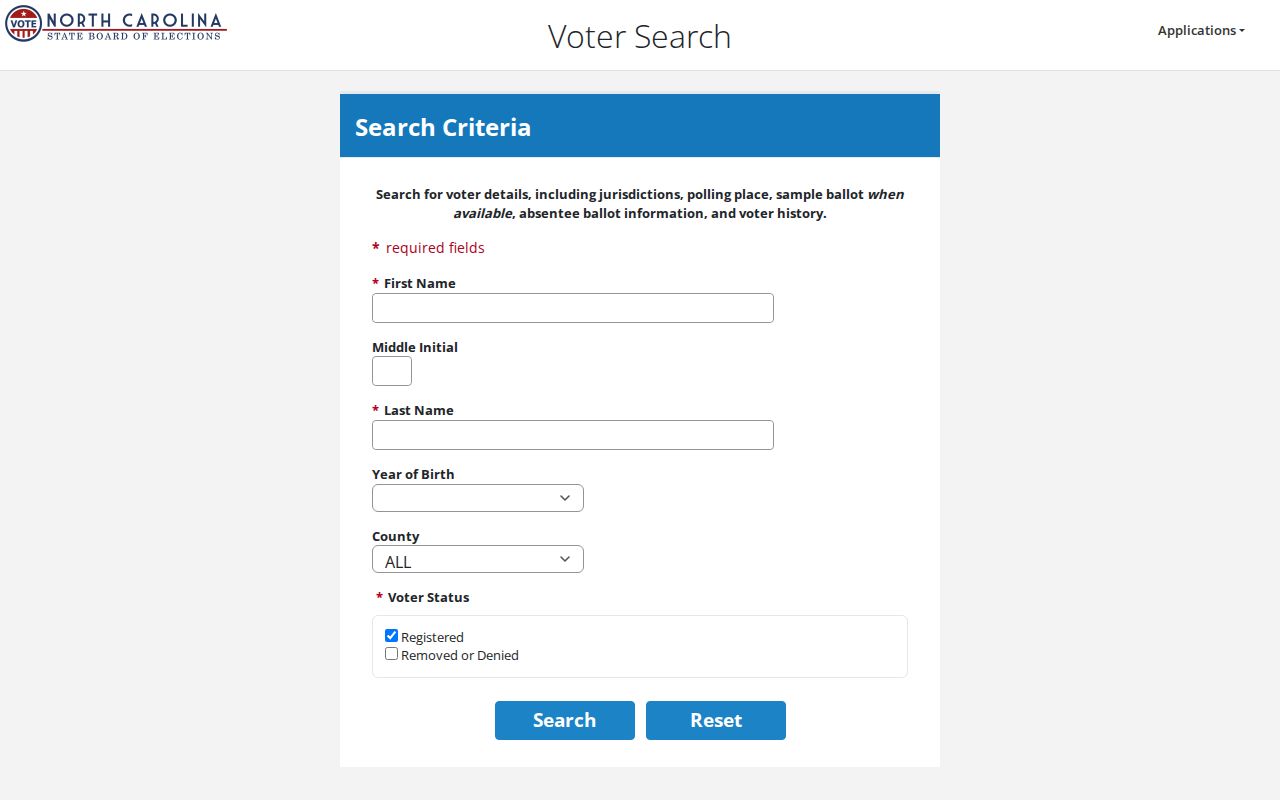
Its county and status controls matter in Kannapolis because one city name can point to either election office and more than one record state.
Read a Kannapolis Voter Profile
A successful match is more than a name-and-address card. The NCSBE voter-record guide divides a profile into six parts: voter details, jurisdictions, voting locations, sample ballots, mail or early-voting ballot status, and voter history. The registration date is the most recent registration date, not proof of when a person first became eligible. County and statewide identifiers also help distinguish people with similar names.
| Identity and status | Name, county, status, county voter number, NCID, registration date, and an NCDMV customer indicator. |
|---|---|
| Public traits | Party or unaffiliated status, race, ethnicity, gender, and age-related data permitted by law. |
| Districts | Precinct, Congress, NC Senate, NC House, courts, prosecutor, county commission, municipality, ward, and school district when applicable. |
| Voting location | Upcoming Election Day site plus county-board contact details and early-voting information. |
| Ballot information | Available sample ballots and the status, type, return date, return method, and return status of a mail or early ballot. |
| Participation | Election, voting method, county of participation, and primary ballot category when relevant. |
A profile can confirm that the municipality field says Kannapolis while the county field says Cabarrus or Rowan. It can also connect the voter to a precinct and local districts that do not follow postal-city labels. Sample ballots appear when available, and unaffiliated voters may see primary options. None of those fields discloses a marked choice.
Kannapolis Voter History Has Limits
Participation history records whether a person voted, where the vote was credited, and the method used. Methods may include Election Day, early voting, absentee by mail, or provisional voting. A primary entry can identify the party primary in which someone took part. A general-election entry leaves that primary field blank. County uploads may take several weeks after an election, so a fresh event may not appear at once.
Participation is not a ballot choice. North Carolina voter history never identifies a candidate, contest selection, or answer marked by an individual voter.
The separate NCSBE voter history files cover the prior ten years and refresh weekly on Sunday evening. They contain registration number, NCID, party, county, precinct, election, and voting method, but not the person’s name or demographic fields. Those files can be joined to registration data through NCID or the combination of county and voter-registration number. For an old election, use the statewide history and filter by the county where the vote occurred. A current county file follows people now registered there, which can distort a historical county count after someone moves.
Note: A recent voter-history gap may reflect county upload timing, not proof that the person did not take part.
Kannapolis Voter Data Stays Private
North Carolina draws a precise line between useful voter records and protected identity data. Under G.S. 163-82.10, the public side can include a name, county voter number, residential and mailing addresses unless protected, sex or gender, race, age but not date of birth, party, precinct, districts, voter history, and an electronically maintained telephone number. A voter signature may be viewed but cannot be copied or traced by the public.
Confidential by statute. Full or partial Social Security numbers, date of birth, driver-license numbers, registration-agency identity, election-law email addresses, voter ID photos, ID photocopies, and qualifying protected addresses are not public under G.S. 163-82.10.
Two download labels can cause needless alarm. The fields named drivers_lic and ssn are yes-or-no indicators showing that a credential was supplied. They do not contain a license number or Social Security digits. The February 2026 public layout also added indicators for the no-license/no-SSN box and whether HAVA identification is required, while continuing to withhold the actual credentials.
Protected Kannapolis Voter Addresses
A qualifying voter can ask the county board to keep a residence address confidential. The supporting document may be a protective order under G.S. 50B-3, another court order that restricts access or contact, or a current Address Confidentiality Program card. A signed statement must explain the risk to the voter or a household family member. The protection lasts while the order or program authorization remains valid.
North Carolina’s Address Confidentiality Program serves eligible survivors of domestic violence, sexual assault, stalking, and human trafficking, along with eligible household members. Election officials use the actual home address to place the voter in the correct precinct, but it stays out of the public record. The substitute address is not used to establish voting residence. The voter’s name, precinct, and other nonprotected registration fields remain public. Law enforcement and a person acting under a court order have narrowly defined access.
Public visibility is never permission to monitor, threaten, impersonate, or harass someone. G.S. 163-275(16) prohibits unauthorized retention of a registrant’s signature, Social Security number, date of birth, or registration-agency identity. A first stalking offense under G.S. 14-277.3A is a Class A1 misdemeanor, with higher felony classes in specified repeat or court-order cases. Knowing unlawful disclosure of how a particular person voted is a Class 1 misdemeanor.
Download Kannapolis Voter Registration Files
The NCSBE voter data portal supplies free, tab-delimited ZIP files for the whole state and for each county. Both Cabarrus and Rowan are available without an account or fee, and the current files refresh each Sunday evening. They include public data for registered and formerly registered people plus attempted or incomplete registrations. Removed records drop out when the most recent voting date is more than ten years old. The public layout documents 70 variables. Along with names and status, it carries residence and mailing fields, phone, registration date, race, ethnicity, party, gender, birth year, precinct, municipality, wards, legislative and court districts, school and service districts, and credential-presence indicators. It also supplies code dictionaries. Election Day and January 1 snapshots reach back more than fifteen years, while election-specific demographic statistics currently extend to 2000.
- Download the current Cabarrus and Rowan ZIP files, then extract the tab-delimited data with the published layout.
- Filter both county files on
municipality_desc = KANNAPOLISand choose the status codes needed for the question. - Record the file date, included statuses, and filters so the count or selection can be reproduced.
- For a custom county, precinct, district, date, or format request, contact the county board. Direct a special statewide request to NCSBE and state the scope and delivery medium.
No current dedicated NCSBE voter-file purchase form was located. That does not block access because the standard state and county downloads are free. For a nonstandard request, supply requester and delivery details, the registration or history file wanted, filters, point-in-time date, and electronic format. G.S. 163-82.13 permits statewide copies at actual preparation cost, while a county magnetic-media list may cost no more than $25 under G.S. 163-82.10.
The official download channel is shown below.
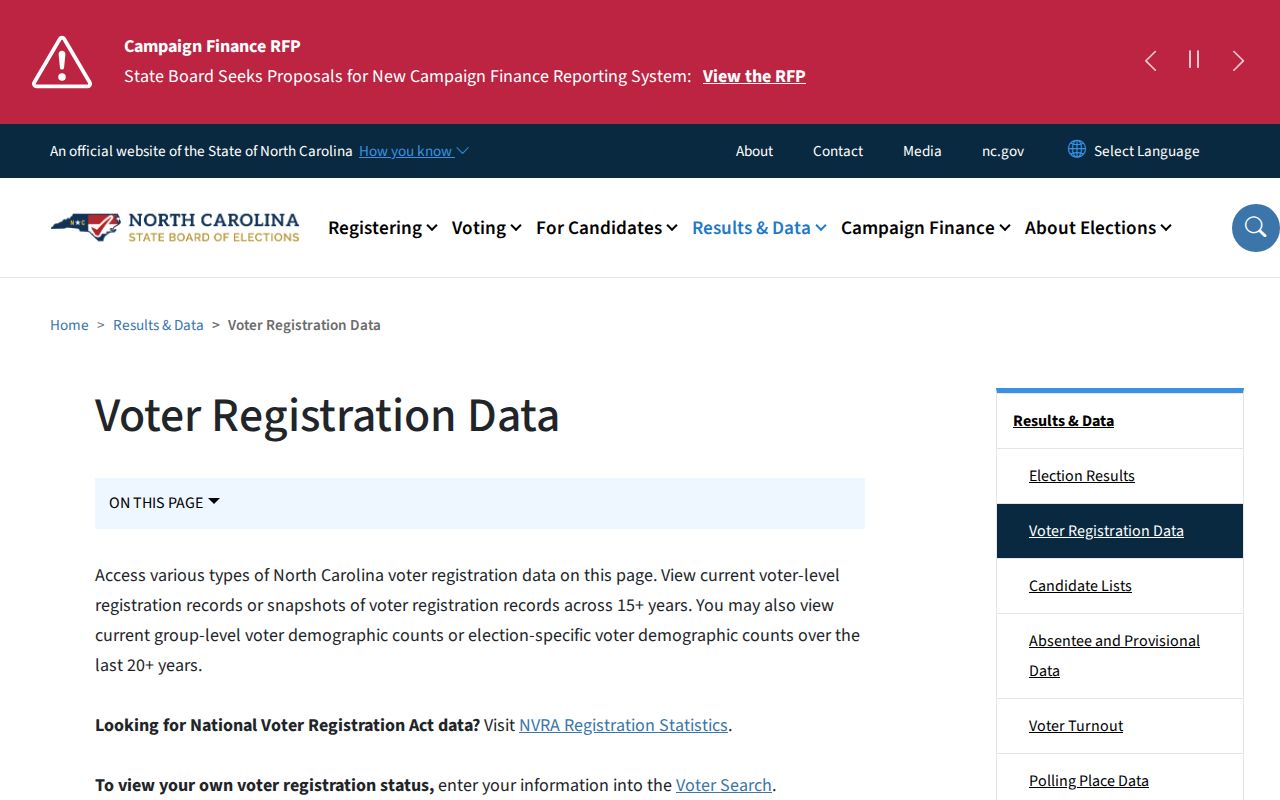
The state and county choices make it possible to isolate Kannapolis correctly without adding two whole-county totals.
Kannapolis County Elections Offices
County boards are the fallback when an online profile is unclear, a special voter-roll selection is needed, or a legacy registration record may still be retained. Residence controls the office. Most of Kannapolis lies in Cabarrus County, while the northern part reaches Rowan County. Both offices publish weekday hours and direct contacts.
Cabarrus County Board of Elections
369 Church Street N
Concord, NC 28025
Monday through Friday, 8 a.m. to 5 p.m.
704-920-2860
elections@cabarruscounty.us
Rowan County Board of Elections
1935 Jake Alexander Boulevard W, Suite D10
Salisbury, NC 28147
Monday through Friday, 8 a.m. to 5 p.m.
704-216-8140
rowan.boe@rowancountync.gov
G.S. 163-82.10 permits any person to request a county list or a reasonable selection by such fields as party, gender, race, registration date, precinct, district, or voter history. A county may recover actual preparation cost and charge no more than $25 for data on magnetic media. The free standard files usually make a custom request unnecessary. Rowan announced an alternate public entrance during construction running into 2026, so call before an in-person visit.
How Kannapolis Voter Rolls Change
Active, inactive, removed, denied, and temporary are distinct states in North Carolina data. Boards maintain the voter rolls through a uniform process under the National Voter Registration Act and G.S. 163-82.14. A record can change after a move, death, duplicate registration, current felony sentence, voter request, successful challenge, or confirmed noncitizenship. Temporary status applies to certain military and overseas voters.
No-contact removal is slow by design. After two federal election cycles with no voting or board contact, officials send a confirmation notice. No response can move the record to inactive. Removal follows only after two more federal cycles without voting or contact. An inactive voter may confirm an address when appearing to vote. A removed voter who appears and affirms continuous residence in the same county may be reinstated.
The state’s maintenance explanation helps distinguish a routine status update from an instant purge. The weekly files also make status a point-in-time fact, not a permanent label. In 2025, the Registration Repair Project gathered missing identifying credentials for incomplete records. Those efforts repaired official data without placing license or Social Security values in the public voter file.
Note: Always note the download date because voter status and municipality fields can change between weekly file releases.
Historic Kannapolis Voter Records
Old poll books and registration registers do not survive in one continuous Kannapolis series. The city was not incorporated until 1984, and its territory has long crossed two county jurisdictions. A historical search must therefore start with both Cabarrus and Rowan records. For the Cabarrus side before that county formed in 1792, Mecklenburg County may also matter.
The State Archives County Records Guide organizes original and microfilm holdings by county and includes election records. Its retention rules define poll and registration lists, rosters, ATV books, registers, and indexes. Routine election lists can be destroyed after set retention periods, but boards must contact the Archives before destroying old poll books and registration books. Exact surviving year spans were not found in an official online finding aid, so ask both county boards and the Archives about a named election or series.
These materials also carry the history of exclusion. North Carolina’s 1900 constitutional amendment used literacy and poll-tax mechanisms plus a grandfather clause to disenfranchise Black voters. A surviving 1902 registration card preserved by NCpedia documents the period. Historic voter records must be read in that legal context: absence from a register can reflect barriers to registration, a lost volume, a short retention period, or the wrong county, not simply a person’s lack of civic interest.